Every day, business owners face tough questions. How much should we charge for this new product? Should we expand our factory or outsource production? How many workers do we need to hire for the upcoming festive season?
Guesswork is dangerous in business. To survive and grow, leaders need a reliable system for making choices. This is where you must clearly define managerial economics.
At its core, managerial economics bridges the gap between abstract economic theory and real-world business practice. It gives managers the tools to analyze data, predict market behavior, and make profitable decisions.
In this comprehensive guide, we will break down exactly what managerial economics means, explore its key components, and show how modern businesses—especially in fast-growing markets like India—use it to stay ahead of the competition.
What Does It Mean to Define Managerial Economics?

To effectively define managerial economics, we must look at its two root words: management and economics.
Management involves organizing resources and guiding a team to achieve a specific goal. Economics is the study of how people and societies choose to use limited resources.
When you combine the two, managerial economics becomes the application of economic theories, concepts, and quantitative methods to solve practical business problems. It takes the formulas found in university textbooks and uses them to maximize profits, minimize costs, and allocate scarce resources (like capital, labor, and materials) efficiently.
Think of it as the compass a ship captain uses. The ocean represents the unpredictable market, and the compass represents managerial economics. It does not control the weather, but it tells the captain the safest and most efficient route to the destination.
The True Nature of Managerial Economics
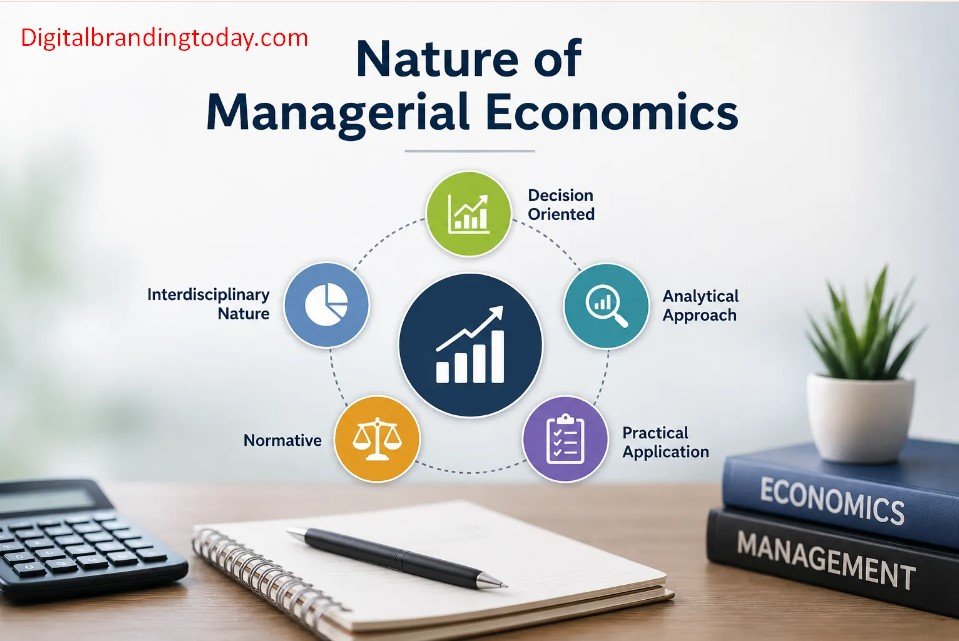
Understanding the nature of this field helps you see how it differs from pure academic study. Here are the core characteristics that define its nature:
1. It is Microeconomic in Character
Managerial economics focuses almost entirely on the microeconomic level. This means it looks at the problems of a single firm or a specific industry rather than the entire national economy. It deals with a company’s internal pricing, production costs, and customer demand rather than national inflation rates or global trade deficits.
2. It takes a Normative Approach
Traditional economics is often positive—it simply describes things as they are (e.g., “If prices rise, demand drops”). Managerial economics is normative. It tells a business what it should do to achieve its goals (e.g., “We should lower our prices by 5% to capture 10% more market share”). It provides a prescription for success.
3. It is Both an Art and a Science
It is a science because it uses rigorous mathematics, statistics, and logical analysis to test data. However, it is also an art because human behavior is never 100% predictable. Managers must use intuition, experience, and creative problem-solving alongside the hard data.
4. It Borrows from Macroeconomics
While its focus is microeconomic, a good manager cannot ignore the outside world. Macroeconomic factors like the Reserve Bank of India (RBI) interest rates, new government tax policies, or changes in the national GDP heavily influence business strategy. Managerial economics uses macro-level data to adjust micro-level plans.
The Scope of Managerial Economics
The scope defines the exact areas of business where these economic principles are applied. If you want to master business decision-making, you need to understand these five core pillars.
Demand Analysis and Forecasting

A business cannot survive without customers. Demand analysis helps a firm understand why consumers buy their product, how much they are willing to pay, and how sensitive they are to price changes (price elasticity).
Demand forecasting takes this a step further by predicting future sales. Before a company builds a new factory, it must forecast whether there will be enough demand for its goods three years from now.
Cost and Production Analysis
Profits are determined by the gap between what you earn and what you spend. Cost analysis helps managers understand their expenses. It divides costs into fixed (rent, salaries) and variable (raw materials, electricity) categories.
Production analysis looks at how efficiently a company turns raw materials into finished goods. The goal is to find the perfect production level where the cost per unit is at its absolute lowest.
Pricing Decisions and Policies
Setting the right price is one of the hardest parts of running a business. Price too high, and you lose customers. Price too low, and you leave money on the table. Managerial economics helps firms choose the right pricing strategy, whether that is penetration pricing (starting low to gain market share) or price skimming (starting high for a premium product).
Profit Management
Profit is the ultimate reward for taking business risks. However, profits are never guaranteed. They fluctuate based on competition, changing costs, and shifting consumer trends. Profit management involves setting realistic profit targets, calculating break-even points, and planning for future financial stability.
Capital Management
Capital refers to the large sums of money a business invests in long-term assets, like heavy machinery, real estate, or new technology. Because these investments are massive and irreversible, managers use capital budgeting techniques to calculate the potential return on investment (ROI) before spending a single rupee.
Why Managerial Economics Matters in India
India is one of the fastest-growing major economies in the world. With a massive consumer base, rapid digital adoption, and a booming startup ecosystem, the Indian market is full of both immense opportunities and brutal competition.
Here is why applying these concepts is critical for Indian businesses:
- Navigating Price Sensitivity: The average Indian consumer is highly value-conscious. Companies must use precise demand and cost analysis to price their products affordably while still protecting their profit margins.
- Resource Scarcity: Many Indian small and medium enterprises (SMEs) operate with limited capital and tight supply chains. Managerial economics helps them allocate these scarce resources without wasting money.
- Scaling Startups: From tech hubs in Bengaluru to fintech companies in Mumbai, startups burn through cash quickly. Economic forecasting helps founders know exactly when to hire, when to expand, and when to conserve cash.
- Adapting to Government Policy: The Indian regulatory environment frequently changes (e.g., GST updates, import duties). Managers use economic frameworks to quickly adapt their pricing and supply chains to new legal realities.
Real-World Examples of Managerial Economics

To truly grasp the concept, let us look at how these principles play out in the real world.
Example 1: Reliance Jio’s Market Entry
When Reliance Jio entered the Indian telecom sector, it used a classic managerial economics strategy: penetration pricing. By offering free data and voice calls initially, they understood the immense price elasticity of Indian telecom users. They absorbed short-term losses (cost analysis) to capture massive market share (demand forecasting), eventually becoming profitable through scale and ecosystem lock-in.
Example 2: Airline Ticket Pricing
Airlines use dynamic pricing, a direct application of managerial economics. They use algorithms to track demand in real-time. A flight from Delhi to Bangalore will cost less on a Tuesday afternoon than on a Friday evening before a long weekend. The airline constantly adjusts the price to maximize revenue for every single seat.
Example 3: FMCG Packaging
During times of high inflation, raw material costs for fast-moving consumer goods (FMCG) rise. Instead of raising the price of a ₹10 biscuit packet (which might destroy demand), companies reduce the weight of the packet from 100 grams to 80 grams. This practice, guided by cost analysis and consumer psychology, maintains the price point while protecting profit margins.
Managerial Economics vs. Traditional Economics

While closely related, these two fields have distinct boundaries. Understanding the difference clarifies the practical value of the managerial approach.
| Feature | Managerial Economics | Traditional Economics |
| Focus Area | Micro-level (Single firm or industry) | Micro and Macro-level (Global or national) |
| Main Goal | Solving practical business problems | Understanding economic principles |
| Nature | Normative (What a business should do) | Positive (What the reality is) |
| Assumptions | Deals with real-world complexities | Relies on theoretical assumptions |
| Scope | Narrow, focused on firm profitability | Broad, focused on societal wealth |
| Use of Data | Relies heavily on internal company data | Relies on national statistics and trends |
Pros and Cons of Applying Managerial Economics

No business framework is perfect. While highly beneficial, there are limitations to relying purely on economic models.
Pros
- Removes Guesswork: Replaces gut feelings with data-driven decision-making.
- Maximizes Efficiency: Helps businesses identify waste and optimize production lines.
- Improves Forecasting: Prepares companies for future market shifts, reducing the risk of sudden bankruptcy.
- Optimizes Pricing: Ensures products are priced perfectly to capture the maximum amount of revenue.
- Simplifies Complex Choices: Breaks down overwhelming problems (like opening a new branch) into manageable mathematical models.
Cons
- High Cost of Implementation: Gathering accurate market data and hiring expert analysts can be expensive for small businesses.
- Predictability Issues: Human behavior is not a math equation. Sudden trends, viral moments, or global crises can render forecasts useless.
- Over-reliance on Historical Data: Economic models rely heavily on what happened in the past, which may not always accurately predict the future.
- Ignores Non-Financial Factors: Strictly economic decisions might ignore company morale, brand reputation, or social responsibilities.
Key Tools and Techniques Used by Managers

To apply these concepts, business analysts rely on a specific set of tools. You do not need to be a mathematician to understand them, but knowing what they do is crucial.
1. Statistical Tools
Managers use statistics to find trends in massive amounts of data. Tools like regression analysis help determine exactly how one factor (like increased advertising spending) affects another (like total sales volume).
2. Linear Programming
This is a mathematical technique used to find the best possible outcome in a given situation. For example, if a factory produces both shoes and belts but has a limited supply of leather, linear programming tells the manager the exact combination of shoes and belts to make to earn the highest total profit.
3. Game Theory
Business is a game of strategy. Game theory helps managers predict how competitors will react to their decisions. If an electronics store lowers the price of its televisions, game theory helps the manager predict whether the rival store across the street will also drop prices or offer a free warranty instead.
4. Break-Even Analysis
This is one of the most fundamental tools in a manager’s kit. It calculates the exact number of units a company must sell to cover all its costs. Any sale beyond the break-even point is pure profit.
Frequently Asked Questions (FAQs)

1. How do you define managerial economics in simple words?
It is the use of economic theories and mathematical tools by managers to solve everyday business problems and make profitable decisions.
2. Who uses managerial economics?
CEOs, financial analysts, marketing managers, production heads, and small business owners use it to guide pricing, hiring, and expansion strategies.
3. Is managerial economics micro or macro?
It is primarily microeconomic because it focuses on the internal workings and decisions of a single firm. However, it uses macroeconomic data (like inflation and interest rates) to understand the external environment.
4. How does managerial economics help in pricing?
It analyzes consumer demand, competitor pricing, and production costs to help a business set a price that maximizes profit without driving buyers away.
5. What is the role of demand forecasting?
Demand forecasting predicts how much of a product consumers will want in the future. This prevents a company from overproducing (wasting money) or underproducing (missing out on sales).
6. Do small businesses need managerial economics?
Yes. While they may not use complex software, basic concepts like break-even analysis, cost tracking, and understanding local demand are vital for small business survival.
7. How is it different from corporate finance?
Corporate finance focuses strictly on managing a company’s money, investments, and debt. Managerial economics is broader, covering consumer behavior, pricing strategies, and production efficiency alongside financial goals.
8. Can managerial economics predict market crashes?
No. It is designed to optimize a specific business’s operations. While it accounts for macroeconomic risks, no tool can perfectly predict sudden global crashes or “black swan” events.
9. What is capital budgeting in this context?
It is the process of evaluating large, long-term investments (like buying a new warehouse) to ensure the future profits will outweigh the immediate costs.
10. Why is normative economics important here?
Because business leaders do not just want to know what is happening in the market; they want to know exactly what actions they should take to improve their situation. Normative economics provides those actionable recommendations.
Final Thoughts
Running a successful business today requires more than just a great product and hard work. It requires strategic thinking and precise decision-making.
When you clearly define managerial economics and apply its principles, you stop making business decisions based on guesswork. You begin looking at your company through the lens of data, demand, and efficiency. Whether you are running a local retail shop in Delhi or leading a multinational tech firm, these economic tools allow you to allocate your resources wisely, price your offerings competitively, and ultimately build a more profitable and resilient organization.
By mastering the balance between economic science and management art, you equip yourself with the ultimate toolkit for business leadership.
Click Here To Learn more: What is Managerial Economics?