Physical Address
304 North Cardinal St.
Dorchester Center, MA 02124
Physical Address
304 North Cardinal St.
Dorchester Center, MA 02124
Every successful business leader eventually faces a critical challenge: bridging the gap between textbook economic theory and real-world corporate survival. This is exactly where managerial economics steps in.
Managerial economics acts as a toolkit for decision-makers. It takes complex economic theories and applies them directly to daily business operations. Whether you are running a tech startup in Bengaluru or managing a massive manufacturing plant in Pune, understanding the scope of managerial economics is essential for minimizing risks and maximizing profits.
This comprehensive guide breaks down exactly what this field covers, from internal operational decisions to external market forces, helping you understand how modern companies navigate uncertainty.

Managerial economics is the practical application of economic concepts, tools, and methodologies to solve business problems. Think of it as a bridge connecting abstract economic theory with practical business management.
Traditional economics might ask, “How does a sudden increase in taxes affect national wealth?” Managerial economics asks a much more specific question: “How does a sudden increase in taxes affect our company’s pricing strategy and profit margins?”
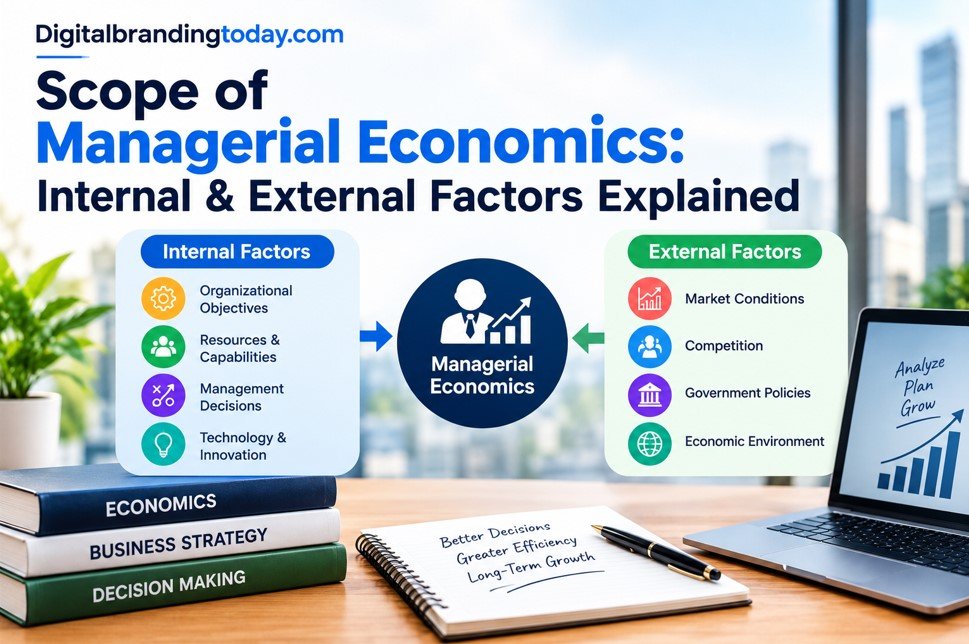
The scope of managerial economics is broad. It is generally divided into two main categories:
Let’s explore both sides in deep detail.

Internal issues are the operational challenges that happen inside the walls of a business. These are the variables that management directly controls. By applying microeconomic principles, business leaders can optimize their internal workflows.
A business cannot survive without customers. Demand analysis helps a company understand the behavior of its consumers. It answers crucial questions: Why do customers buy this product? How do price changes affect their buying habits?
Demand forecasting takes this a step further by predicting future sales. This is vital for preparing production schedules. For example, an e-commerce platform gearing up for the Diwali festive season must accurately forecast demand. If they underestimate it, they face stockouts and angry customers. If they overestimate it, they waste money storing unsold goods.
Key aspects included in this scope are:
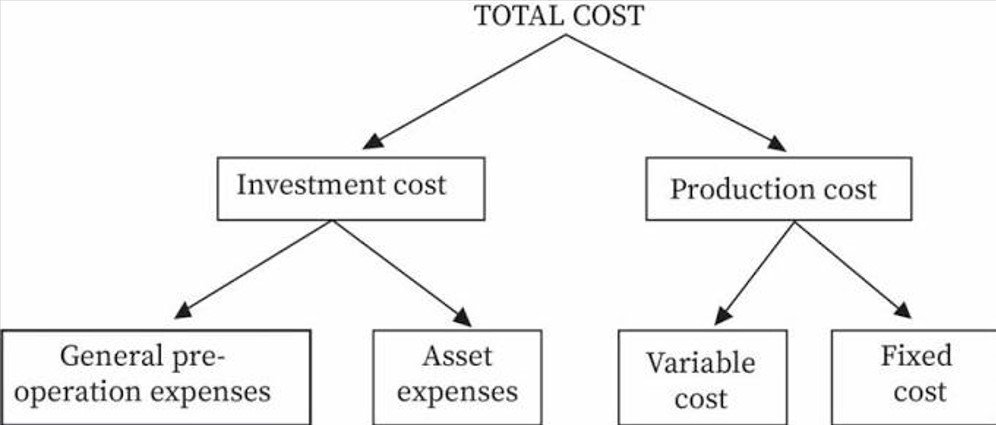
Profit is simply revenue minus costs. Therefore, controlling costs is just as important as generating sales. Cost analysis involves identifying all the different expenses a company faces and finding ways to minimize them without sacrificing quality.
Managers must understand different cost concepts, such as fixed costs (rent, salaries), variable costs (raw materials), and opportunity costs (what you lose by choosing one option over another).
Production analysis looks at the physical process of turning inputs (labor, materials) into outputs (finished goods). The goal here is efficiency.
Setting the right price is one of the most stressful tasks for any management team. Price a product too high, and your competitors will steal your market share. Price it too low, and you leave money on the table or even operate at a loss.
Managerial economics provides frameworks for pricing strategies based on the specific market structure a business operates in.
Pricing policies covered in this scope include:
In a perfect world, a business would always make a predictable profit. In reality, profits are highly uncertain because they depend on both internal efficiency and external market conditions.
Profit management involves planning and measuring profitability over time. It requires managers to make calculated bets on future revenues while strictly controlling current budgets.
Crucial elements of profit management include:
Capital management is the process of planning and controlling a company’s financial resources. Because capital is expensive and limited, deciding where to invest it is a high-stakes game.
If a manufacturing firm wants to build a new factory in Gujarat, management must evaluate if the future returns from that factory will justify the massive upfront costs.
The scope of capital management involves:
Inventory is essentially cash sitting on a warehouse shelf. Holding too much inventory ties up working capital and increases storage costs. Holding too little disrupts the supply chain and halts production.
Managerial economics uses specific models to solve this balancing act.

While managers have control over internal pricing and production, they have zero control over the global economy. However, they must still anticipate and react to these external macroeconomic forces.
A company’s success is heavily tied to the overall health of the country’s economy. The general economic environment includes the national income, employment rates, and overall consumer purchasing power.
When the economy is growing, consumers have more disposable income, making it easier for businesses to sell premium products. Conversely, during an economic downturn, consumers tighten their belts. Management must constantly monitor these shifts. They look at data like Gross Domestic Product (GDP) growth, national savings rates, and per capita income to decide if it is safe to expand their business.
Economies never move in a straight line. They go through cyclical phases: expansion, peak, contraction (recession), and trough.
Understanding business cycles is a massive part of the scope of managerial economics.
By reading the early warning signs of a shifting business cycle, a company can brace for impact before its competitors do.
No business operates in a vacuum. Every company must navigate the complex web of government rules, taxes, and trade policies. In a rapidly growing market like India, these policies can change frequently, creating both massive opportunities and sudden risks.
Managerial economists closely monitor:
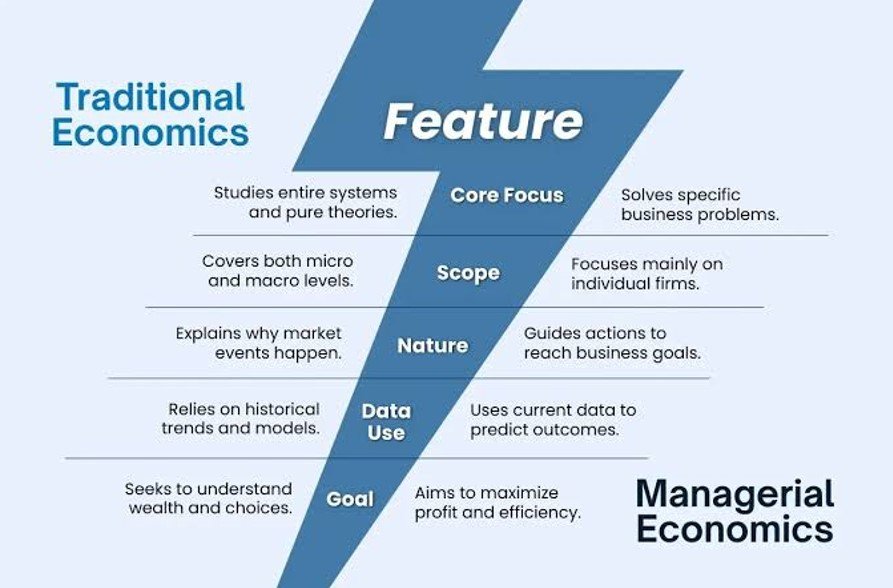
To truly understand the scope of managerial economics, it helps to see how it differs from traditional economics.
| Feature | Traditional Economics | Managerial Economics |
| Primary Focus | Theoretical and abstract concepts. | Practical application and problem-solving. |
| Scope | Very broad (covers both micro and macro extensively). | Narrower (focuses mostly on micro issues relevant to a specific firm). |
| Nature | Positive (describes what is happening in the economy). | Normative (suggests what should be done by the business). |
| Assumptions | Often assumes a flawless, rational, perfect market. | Operates in the real world of uncertainty and imperfect markets. |
| Goal | To understand human behavior and resource allocation globally. | To maximize profits, efficiency, and growth for a single organization. |
| Decision Making | Rarely involves direct corporate decision-making. | Entirely focused on facilitating management decisions. |
Like any business tool, applying economic theory to management has its distinct advantages and inherent limitations.
The primary objective is to help business leaders make rational, data-backed decisions that maximize profits, minimize costs, and ensure the long-term survival of the firm under uncertain conditions.
It is primarily microeconomic in nature because it focuses on the internal workings of a specific firm (like pricing and production). However, it definitely uses macroeconomic principles to understand external threats like inflation and government policies.
It analyzes market structures, competitor behavior, and consumer price elasticity. This allows managers to determine the optimal price point that will generate the highest total revenue without losing market share.
Demand forecasting allows a business to predict future sales based on past data and market trends. This ensures the company produces the exact right amount of product, avoiding both costly stockouts and expensive overstocking.
Capital investments (like buying machinery or opening new branches) are expensive and irreversible. Managerial economics provides tools to evaluate the potential return on investment (ROI) to ensure a company’s funds are not wasted on unprofitable projects.
Macroeconomic factors like inflation, taxation, and interest rates dictate the environment a business operates within. For instance, high inflation increases raw material costs, forcing managers to either absorb the loss or raise product prices.
It is a normative science. While traditional economics is positive (it simply states facts about the economy), managerial economics prescribes solutions. It tells managers what they ought to do to solve a specific problem.
Absolutely. While a small local bakery might not use complex statistical software, the owner still applies these concepts when they calculate their break-even point, adjust prices based on competitor bakeries, or forecast demand for weekend sales.
Opportunity cost is the value of the next best alternative that is given up when making a decision. If a company uses its factory to produce Product A, the opportunity cost is the profit they could have made if they used that same factory to produce Product B.
Inventory management uses economic formulas (like the Economic Order Quantity) to balance the cost of storing unsold goods against the risk of running out of stock, ensuring the company operates at maximum financial efficiency.
The scope of managerial economics is vast, dynamic, and absolutely critical to modern business management. It serves as the ultimate analytical toolkit, empowering leaders to navigate the chaotic waters of commerce with clarity and confidence.
By mastering the internal microeconomic factors—such as demand forecasting, cost control, pricing strategies, and capital allocation—a business can build a highly efficient and profitable foundation. Furthermore, by staying alert to the external macroeconomic environment—including business cycles, inflation, and shifting government regulations—a company can shield itself from sudden market shocks.
Ultimately, managerial economics transforms abstract textbook theories into actionable, real-world strategies. In today’s hyper-competitive and rapidly changing business landscape, a deep understanding of this discipline is no longer just an academic advantage; it is a fundamental requirement for long-term corporate survival.