Physical Address
304 North Cardinal St.
Dorchester Center, MA 02124
Physical Address
304 North Cardinal St.
Dorchester Center, MA 02124
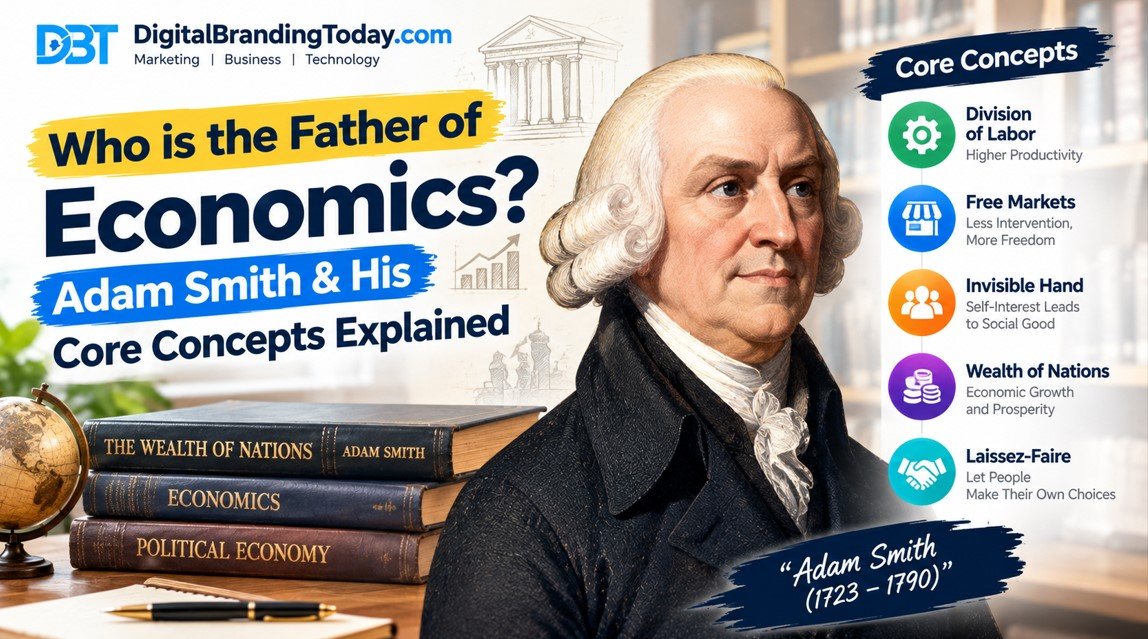
If you have ever wondered why prices change, why certain countries are wealthier than others, or how businesses decide what to produce, you are asking economic questions. The modern framework we use to answer these questions did not appear overnight. It was shaped by a Scottish philosopher in the 18th century who fundamentally changed how the world views wealth and trade.
Adam Smith is universally recognized as the father of economics. His groundbreaking ideas broke away from the rigid, government-controlled systems of his time and laid the foundation for modern capitalism.
In this comprehensive guide, we will explore exactly why Adam Smith earned this title, unpack the core concepts of his most famous book, and look at how his theories compare to ancient Indian economic thought.

Adam Smith (1723–1790) holds the title of the father of economics, or more specifically, the father of modern economics and capitalism. He was a Scottish moral philosopher, a pioneer of political economy, and a key figure during the Scottish Enlightenment.
Before Smith, economics was not considered a standalone academic discipline. It was deeply entangled with moral philosophy, politics, and law. Smith was the first to systematically compile, analyze, and publish a comprehensive theory on how economies function in the real world. By treating economics as a distinct science, he gave future generations the tools to measure, predict, and encourage economic growth.
Understanding the father of economics requires looking at his background. Born in Kirkcaldy, a small town in Scotland, Smith showed an early aptitude for academics. He entered the University of Glasgow at the young age of 14, where he studied moral philosophy under Francis Hutcheson. Hutcheson’s views on human liberty and reason deeply influenced Smith’s later work.
Smith later attended Balliol College at Oxford University, though he found the teaching there less stimulating than in Glasgow. After returning to Scotland, he began delivering highly successful public lectures in Edinburgh. This success led to his appointment as a professor at the University of Glasgow, where he published his first major work in 1759, The Theory of Moral Sentiments.
While today he is famous for economics, The Theory of Moral Sentiments focused on human morality and ethics. In it, Smith argued that human beings are driven by self-interest but also possess a natural sympathy for others. This dual nature—acting for oneself while being aware of the community—became the philosophical bedrock for his later economic theories.
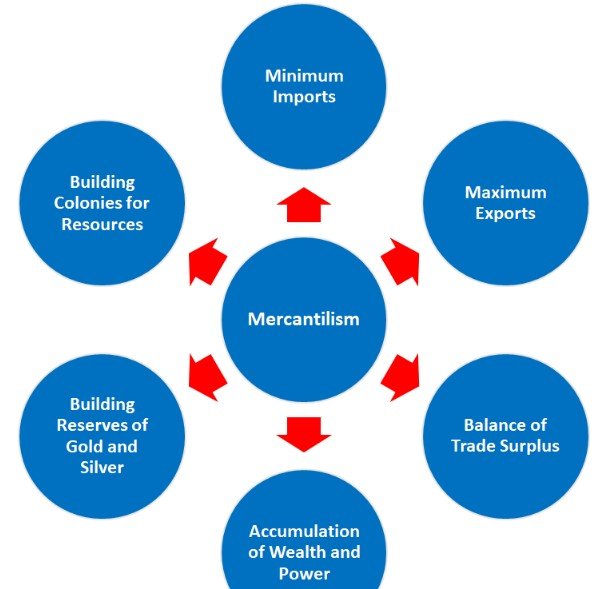
To truly appreciate why Adam Smith’s ideas were revolutionary, we must understand the economic system he was fighting against: Mercantilism.
During the 16th to 18th centuries, European nations operated under the belief that the world’s wealth was strictly limited. Wealth was measured entirely by how much gold and silver a country held in its vaults.
Under mercantilism, governments heavily controlled the economy to maximize exports and minimize imports. They believed that if you bought goods from another country, you were losing gold, and therefore losing wealth. Governments imposed high tariffs, granted monopolies to favored companies (like the East India Company), and heavily regulated domestic businesses.
Adam Smith viewed this system as deeply flawed. He recognized that hoarding gold did not improve the daily lives of citizens. He argued that a nation’s true wealth was not its gold reserves, but the total sum of goods and services produced by its people. This metric is what we now call Gross Domestic Product (GDP).
In 1776, Adam Smith published his magnum opus: An Inquiry into the Nature and Causes of the Wealth of Nations (usually shortened to The Wealth of Nations).
This book took him ten years to write and was published in the very same year that the United States declared its independence. Just as the American Revolution sought political freedom, The Wealth of Nations argued for economic freedom.
The book systematically dismantled the arguments of mercantilism. It provided a clear, logical explanation of how free markets could coordinate human activity without the need for heavy-handed government intervention. By doing so, it established classical economics.
Adam Smith introduced several foundational concepts that are still taught in high schools and universit
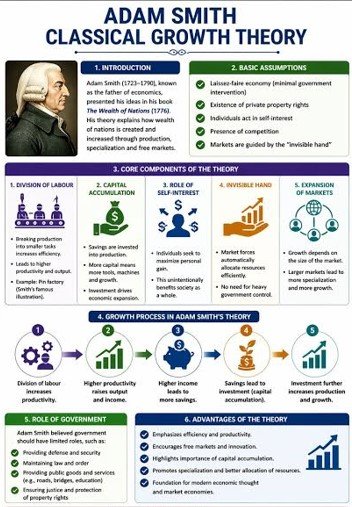
ies around the world today. Here is a breakdown of his most critical ideas:
This is arguably the most famous metaphor in all of economics. Smith argued that when individuals pursue their own self-interest in a free market, they unintentionally benefit society as a whole.
For example, a baker does not bake high-quality bread out of sheer kindness. He does it to make a profit and support his family. However, to get customers, he must offer good bread at a fair price. In pursuing his own selfish goal, he provides a valuable good to his community. Smith described this self-regulating nature of the marketplace as being guided by an “invisible hand.”
Laissez-faire is a French term that loosely translates to “leave it alone.” Smith was a strong advocate for minimizing government intervention in the economy. He believed that when the government dictates prices, heavily taxes trade, or grants monopolies, it distorts the natural balance of supply and demand. According to Smith, markets operate most efficiently when they are left alone to self-correct.
Smith observed that economic productivity skyrockets when work is divided into specific, specialized tasks. In The Wealth of Nations, he famously used a pin factory to illustrate this.
If one worker tried to make a pin from scratch—drawing the wire, cutting it, sharpening it, and attaching the head—they might make only a few pins a day. But if the task is divided among ten workers, each specializing in one specific step, they can collectively produce tens of thousands of pins a day. This concept of specialization is the core driver of industrialization and modern mass production.
Also known as the diamond-water paradox, Smith explored why essential goods are often cheap while non-essential goods are expensive. Water is absolutely vital for human survival, yet it is generally very cheap. Diamonds, on the other hand, have very little practical use, but they are incredibly expensive.
Smith explained this by distinguishing between “value in use” and “value in exchange.” While water has high use-value, it is abundant, giving it low exchange-value. Diamonds are scarce and require immense labor to extract, giving them high exchange-value despite low use-value. (Later economists would refine this further with the theory of marginal utility).
While Adam Smith is the undisputed father of modern economics, students in India often look back much further in history to find the roots of economic thought.
More than 2,000 years before Adam Smith was born, an ancient Indian polymath named Chanakya (also known as Kautilya or Vishnugupta) wrote a massive treatise on statecraft, economic policy, and military strategy called the Arthashastra.
Written roughly around the 3rd century BCE during the Mauryan Empire, the Arthashastra translates directly to “The Science of Wealth.” Chanakya served as the chief advisor to Emperor Chandragupta Maurya and helped build one of the largest empires in ancient Indian history.
Unlike Smith, who focused on free markets and individual liberty, Chanakya approached economics from the perspective of the state. He provided detailed instructions on how a king should manage agriculture, taxation, mining, and trade to ensure a prosperous kingdom. He argued that a well-managed economy was the foundation of a strong military and a stable society. For this reason, many scholars consider Chanakya to be the ancient, or Indian, father of economics.
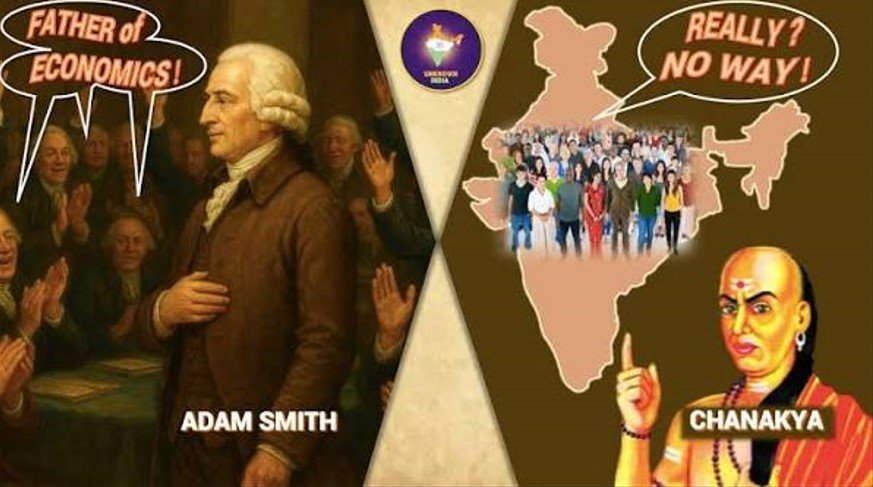
To understand how economic thought has evolved from ancient times to the modern era, it is helpful to contrast these two historical giants.
| Feature | Adam Smith (Modern Father) | Chanakya (Ancient Father) |
| Era | 18th Century CE (Scottish Enlightenment) | 3rd Century BCE (Mauryan Empire) |
| Key Text | The Wealth of Nations | The Arthashastra |
| Primary Focus | Free markets, individual self-interest | Statecraft, wealth generation for the empire |
| View on Government | Minimal intervention (Laissez-faire) | Centralized control and heavy regulation |
| Core Concept | The Invisible Hand, Division of Labour | Taxation systems, public welfare, trade policies |
| Target Audience | Philosophers, merchants, lawmakers | Kings, administrators, and political leaders |
Adam Smith’s classical economic theories transformed the world, pulling millions out of poverty by encouraging global trade and innovation. However, his theories are not without criticism. Modern economists recognize both the strengths and the limitations of a purely Smithian approach.
Pros:
Cons:
Economics is a massive field divided into several branches. While Adam Smith is the overarching founder, other brilliant minds are considered the “fathers” of specific sub-disciplines:
While Smith focused on how individual markets worked, John Maynard Keynes looked at the economy as a massive, unified machine. Writing during the Great Depression in the 1930s, Keynes argued that free markets don’t always self-correct quickly. He believed that during severe downturns, governments must step in and spend money to stimulate the economy and create jobs. His ideas formed the basis of modern macroeconomics.
If macroeconomics looks at the whole forest, microeconomics looks at the individual trees. Alfred Marshall is heavily credited with formalizing microeconomics in the late 19th century. He popularized the famous supply and demand curves that every business student learns today, bringing rigorous mathematical and graphical analysis to Smith’s earlier ideas.
Adam Smith, an 18th-century Scottish philosopher, is universally recognized as the father of modern economics.
His most famous and influential work is An Inquiry into the Nature and Causes of the Wealth of Nations, published in 1776.
The invisible hand is a metaphor used by Adam Smith to describe how individuals acting in their own self-interest naturally regulate the free market, unintentionally benefiting society through competition and innovation.
Chanakya (also known as Kautilya), who lived in the 3rd century BCE, is often referred to as the Indian or ancient father of economics due to his comprehensive text on statecraft and wealth management, the Arthashastra.
Laissez-faire is an economic philosophy advocating that the government should intervene as little as possible in the direction of economic affairs.
Yes, despite his preference for free markets, Smith was not an anarchist. He believed government was necessary for national defense, justice systems, and public infrastructure (like roads and schools), and therefore supported fair, proportionate taxation.
Unlike mercantilists who defined wealth by gold and silver reserves, Smith defined a nation’s wealth by the total volume of goods and services it could produce for its citizens (similar to modern GDP).
It is the process of breaking down a large job into smaller, specialized tasks assigned to different workers. Smith argued this drastically increases productivity and efficiency.
John Maynard Keynes is considered the father of macroeconomics for his 20th-century theories on government intervention during economic depressions.
Smith’s core principles—competition, supply and demand, and the dangers of excessive government control and monopolies—remain the foundational pillars of the global capitalist system operating today.
The study of how we allocate scarce resources to fulfill unlimited wants is a complex, ever-evolving science. However, it all traces back to a Scottish philosopher who looked at the rigid, gold-obsessed policies of the 18th century and imagined a better way.
Adam Smith, the rightful father of economics, shifted the world’s focus from hoarding wealth to creating wealth. By championing the division of labor, recognizing the power of the invisible hand, and advocating for free trade, he laid the intellectual groundwork for the industrial revolution and modern global commerce.
While modern economic theories have evolved to address market failures, environmental concerns, and wealth inequality—issues Smith could hardly have predicted—his core belief in human ingenuity and the power of free exchange remains as relevant today as it was in 1776. Whether you are studying the ancient administrative genius of Chanakya in India or the modern theories of Keynes, every economic discussion ultimately builds upon the foundation laid by Adam Smith.