
Every successful business leader eventually faces the same problem: how do you make the right choice when resources are limited? Whether you run a bustling tech startup in Bengaluru or a massive manufacturing plant in Pune, you cannot rely on guesswork.
This is where managerial economics steps in.
It acts as a bridge between abstract economic theories and practical business management. By using logical frameworks, managers can solve complex everyday problems. In this guide, we will explore the exact nature of managerial economics, uncover its core characteristics, and show you how it drives modern business success.
What is Managerial Economics?
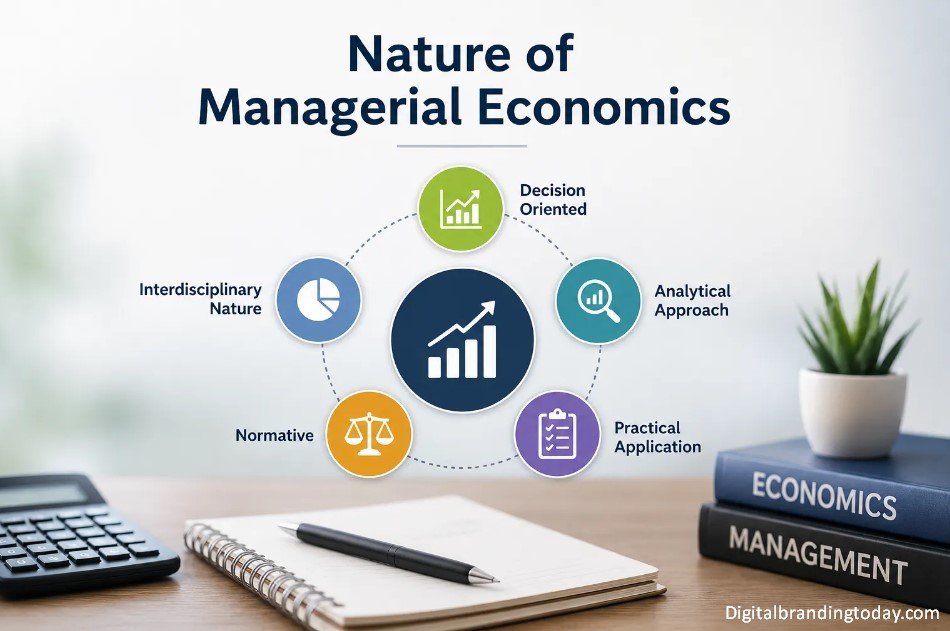
explain the nature of managerial economics
Before diving into its nature, we must define the concept. Managerial economics is the application of economic theory and mathematical tools to solve real-world business problems. It helps executives make logical decisions about pricing, production, and investments.
Think of traditional economics as a massive textbook of rules. Managerial economics takes only the rules that apply to a specific company and uses them to maximize profits. It translates complex economic data into actionable business strategies.
The Core Nature of Managerial Economics
To truly understand the nature of managerial economics, we have to look at its primary characteristics. It is not just one single idea. Instead, it is a blend of several different approaches. Here are the main features that define its nature.
1. Microeconomic in Character
The foundation of managerial economics is microeconomics. It focuses entirely on the individual firm rather than the entire country’s economy.
A manager does not wake up and try to solve India’s national unemployment rate. Instead, they ask questions like:
- How many units of this product should our factory produce?
- What price should we charge to maximize our revenue?
- How many workers does our business need to hire?
Because it deals with the problems of a single organization, its nature is inherently microeconomic.
2. Normative Rather Than Positive
In standard economics, we divide studies into two categories: positive and normative.
- Positive economics simply states facts. (Example: “If prices go up, demand goes down.”)
- Normative economics tells us what we should do. (Example: “We should lower our prices to capture more market share.”)
The nature of managerial economics is highly normative. It does not just describe business environments; it prescribes solutions. It acts as a guide, helping business owners figure out the best course of action to achieve their goals.
3. Pragmatic and Applied Approach
Traditional economics often relies on unrealistic assumptions, like the idea of “perfect competition” where every buyer and seller knows everything. In the real world, things are much messier.
Managerial economics is incredibly pragmatic. It throws away unrealistic assumptions and deals with practical realities. If an Indian telecom company wants to launch a new 5G plan, it knows it operates in an oligopoly (a market with only a few competitors). Managerial economics adapts traditional theories to fit these real, imperfect markets.
4. Uses Macroeconomics for Business Environment
While managerial economics focuses on the micro level, it does not completely ignore macroeconomics. A smart manager must understand the external environment.
A firm does not operate in a vacuum. External factors like the Reserve Bank of India (RBI) changing interest rates, national inflation, or global supply chain issues directly impact a company’s bottom line. Therefore, a key part of its nature is understanding how macroeconomic trends affect microeconomic decisions.
5. Multi-Disciplinary Roots
Managerial economics does not stand alone. It borrows heavily from other fields of study to build its solutions. Its multi-disciplinary nature includes:
- Statistics: To analyze past sales data.
- Mathematics: To calculate maximum profits and minimum costs.
- Accounting: To understand cash flow and profit margins.
- Operations Research: To optimize supply chains and logistics.
By combining these subjects, managers get a complete 360-degree view of their business problems.
6. Management-Oriented and Forward-Looking
The ultimate goal of this field is to help management make decisions. The nature of managerial economics is heavily focused on forward planning.
Business is about the future. Managers must forecast demand, predict cost changes, and plan capital investments for the next five to ten years. Managerial economics provides the forecasting tools needed to look ahead with confidence.
Managerial Economics vs. Traditional Economics
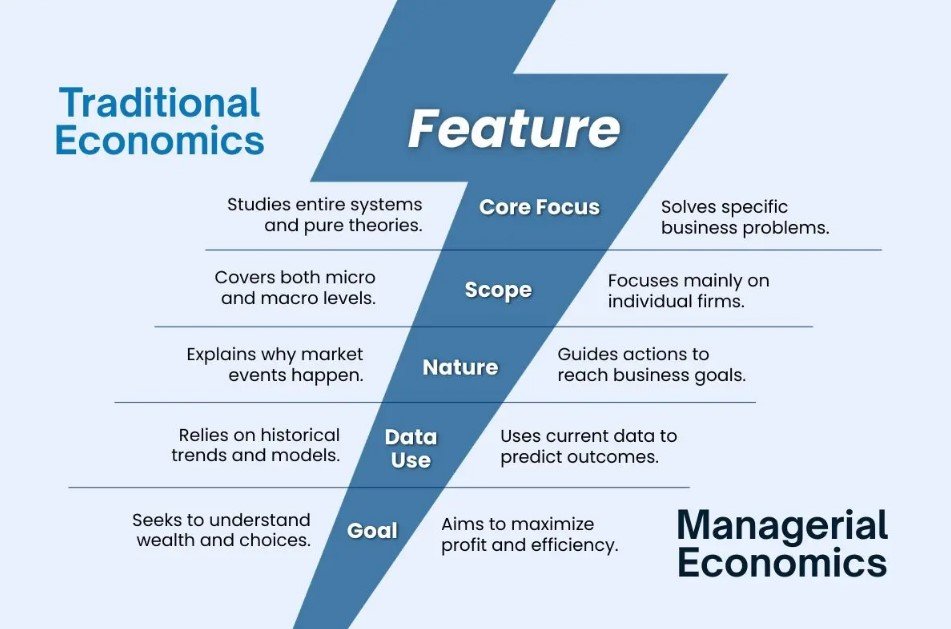
Many people confuse managerial economics with traditional economic theory. While they are related, they serve completely different purposes.
Below is a detailed comparison table highlighting the differences:
| Feature | Traditional Economics | Managerial Economics |
| Primary Scope | Covers both microeconomics and macroeconomics broadly. | Primarily focuses on microeconomics (the individual firm). |
| Nature of Study | Both Positive (what is) and Normative (what should be). | Strictly Normative (prescribes solutions for the business). |
| Assumptions | Often relies on abstract, theoretical assumptions. | Highly practical; adjusts theories to fit real-world scenarios. |
| Goal | To understand how wealth is produced and consumed in society. | To maximize profits and minimize costs for a specific business. |
| Use of Data | Focuses on national or global data (GDP, inflation). | Focuses on company-specific data (sales, internal costs). |
| Complexity | Academic and theoretical. | Applied, multi-disciplinary, and solution-oriented. |
The Scope of Managerial Economics
Understanding the nature of managerial economics naturally leads us to its scope. The scope defines the actual areas of business where these economic principles are applied.
Demand Analysis and Forecasting
A business cannot survive if no one wants its product. Demand analysis helps a company understand consumer behavior. Demand forecasting takes it a step further by predicting how much of a product consumers will buy in the future.
- Example: A retail brand in Mumbai uses past Diwali sales data to forecast how much inventory they need for the upcoming festive season.
Cost and Production Analysis
Managers must know exactly how much it costs to produce an item. Cost analysis breaks down fixed costs (like factory rent) and variable costs (like raw materials). Production analysis helps the firm figure out the most efficient way to combine labor and machinery to keep those costs low.
Pricing Decisions and Policies
Setting the right price is critical. Price it too high, and customers walk away. Price it too low, and you lose money. Managerial economics helps firms choose the best pricing strategy.
- Example: When a new tech company enters the market, they might use penetration pricing (setting low prices initially) to steal customers from competitors.
Profit Management
Profit is the ultimate goal of any commercial enterprise. However, profits are never guaranteed due to market risks. Managerial economics gives leaders the tools to measure profit effectively, plan for unexpected losses, and ensure the company remains financially healthy during tough economic times.
Capital Budgeting
Capital management involves making decisions about massive investments. Should a hospital buy a ₹10 Crore MRI machine? Should a logistics company expand its fleet of trucks? Managerial economics provides formulas—like Net Present Value (NPV)—to determine if a long-term investment will actually pay off.
Why Indian Businesses Need Managerial Economics

The Indian business landscape is unique. It features massive conglomerates, millions of Micro, Small, and Medium Enterprises (MSMEs), and a booming startup ecosystem. The nature of managerial economics makes it perfectly suited for this fast-growing environment.
- Intense Competition: With foreign brands entering India and local startups disrupting old industries, businesses must optimize their costs. Managerial economics helps Indian firms stay competitive by finding the most efficient production methods.
- Resource Scarcity: Capital and skilled labor can be scarce. Economic frameworks help managers allocate their limited rupees to projects that offer the highest returns.
- Price-Sensitive Consumers: The Indian market is famously price-sensitive. Companies must use advanced pricing theories to find the exact “sweet spot” where consumers are willing to buy, and the company still makes a profit.
- Navigating Government Policies: Changes in GST, import duties, and RBI interest rates constantly shift the market. Managerial economics helps leaders analyze these macroeconomic changes and adjust their micro-level strategies accordingly.
Pros & Cons of Managerial Economics
Like any business tool, managerial economics has distinct advantages and a few limitations.
The Pros
- Better Decision-Making: It removes emotion and guesswork from business choices. Managers rely on solid math and economic logic.
- Risk Reduction: Forecasting tools help businesses prepare for market downturns, reducing financial risk.
- Optimal Resource Allocation: It ensures that money, time, and labor are not wasted on unprofitable ventures.
- Clear Pricing Strategies: It provides mathematical backing for how to price products in various market structures.
The Cons
- Relies on Accurate Data: If a company’s historical data is flawed, the economic forecasts will be entirely wrong. “Garbage in, garbage out.”
- Ignores Human Elements: Economic formulas do not account for employee morale, workplace culture, or human psychology.
- High Implementation Cost: Small businesses often cannot afford to hire dedicated business economists or expensive data analysis software.
- Unpredictable Markets: No matter how good the economic model is, unpredictable events (like a global pandemic) can render previous forecasts useless.
Frequently Asked Questions (FAQs)
1. What is the primary nature of managerial economics?
The primary nature of managerial economics is that it is an applied, normative, and microeconomic discipline. It takes economic theories and applies them to real-world business scenarios to help managers make logical, profitable decisions.
2. Is managerial economics a positive or normative science?
It is fundamentally a normative science. While positive science simply states facts (“Interest rates have risen”), normative science prescribes actions (“Because interest rates have risen, we should delay taking out a new business loan”). Managerial economics focuses on what a business should do.
3. Why is it considered microeconomic in nature?
It is microeconomic because it focuses on the internal operations, costs, and revenues of a single firm. It deals with individual consumers and individual products rather than the entire national economy.
4. Does macroeconomics play a role in managerial economics?
Yes, absolutely. While the core is microeconomic, managers must understand the macroeconomic environment. Factors like national inflation rates, taxation policies, and overall economic growth directly affect consumer spending and business costs.
5. How does it help in business decision-making?
It provides quantitative tools (like cost-volume-profit analysis and demand forecasting) that allow managers to evaluate different choices. Instead of guessing, a manager can calculate exactly which decision will yield the highest profit.
6. What is the difference between managerial economics and traditional economics?
Traditional economics is broader, highly theoretical, and studies the entire economy (both micro and macro). Managerial economics is narrower, highly practical, and tailored specifically to solve problems for business management.
7. Is managerial economics an art or a science?
It is both. It is a science because it uses structured mathematical formulas, statistical data, and proven economic laws. It is an art because a manager must use creative judgment, intuition, and leadership to apply these laws to unpredictable human markets.
8. What are the main tools used in this field?
The most common tools include statistical regressions (for demand forecasting), accounting metrics, capital budgeting formulas (like ROI and NPV), and operations research methods (like linear programming).
9. Can small businesses benefit from managerial economics?
Yes. While MSMEs might not hire dedicated economists, the basic principles—like tracking variable costs, understanding competitor pricing, and managing inventory based on past demand—are crucial for small business survival.
10. How do Indian companies use managerial economics?
Indian companies use it to navigate a highly competitive, price-sensitive market. They use demand forecasting during festival seasons (like Diwali), apply cost analysis to deal with supply chain disruptions, and use pricing strategies to compete with both local startups and global giants.
Conclusion
The nature of managerial economics is dynamic, practical, and incredibly powerful. It transforms economics from a dusty academic subject into a sharp toolkit for modern business leaders.
By being microeconomic in focus, normative in its approach, and deeply pragmatic, it allows executives to navigate complex business landscapes. Whether you are trying to price a new software service, deciding where to build your next warehouse, or planning a budget for the upcoming fiscal year, managerial economics provides the roadmap.
In a world where margins are tight and competition is fierce, understanding and applying these principles is no longer optional—it is the baseline requirement for sustainable business success. Leaders who master the nature of managerial economics do not just survive the market; they dominate it.